What’s the story?
Drawing from Aeschylus’ trilogy of Greek tragedies, Simon Stone’s newest modernisation takes place in and around the home of Christopher and Montgomery “Montie” Middleton, thoroughly minted thanks to his role in the family business. On the day of their twin daughters’ twenty-first birthday things go dangerously awry when Middletech’s involvement in overseas conflict leads to protest action and a familial arrest, setting a decade of dark and eventually bloody events into motion.
Where is it playing?
The Oresteia plays at the Bridge Theatre until September 19th 2026
Tickets and further information can be found on the theatre’s website
This review was written of my own volition, having paid to attend.
L-R: Archie Medekwe, Mary-Louise Parker, David Morrissey, Lloyd Hutchinson
Photography by Johan Persson
Spoiler-Free Thoughts
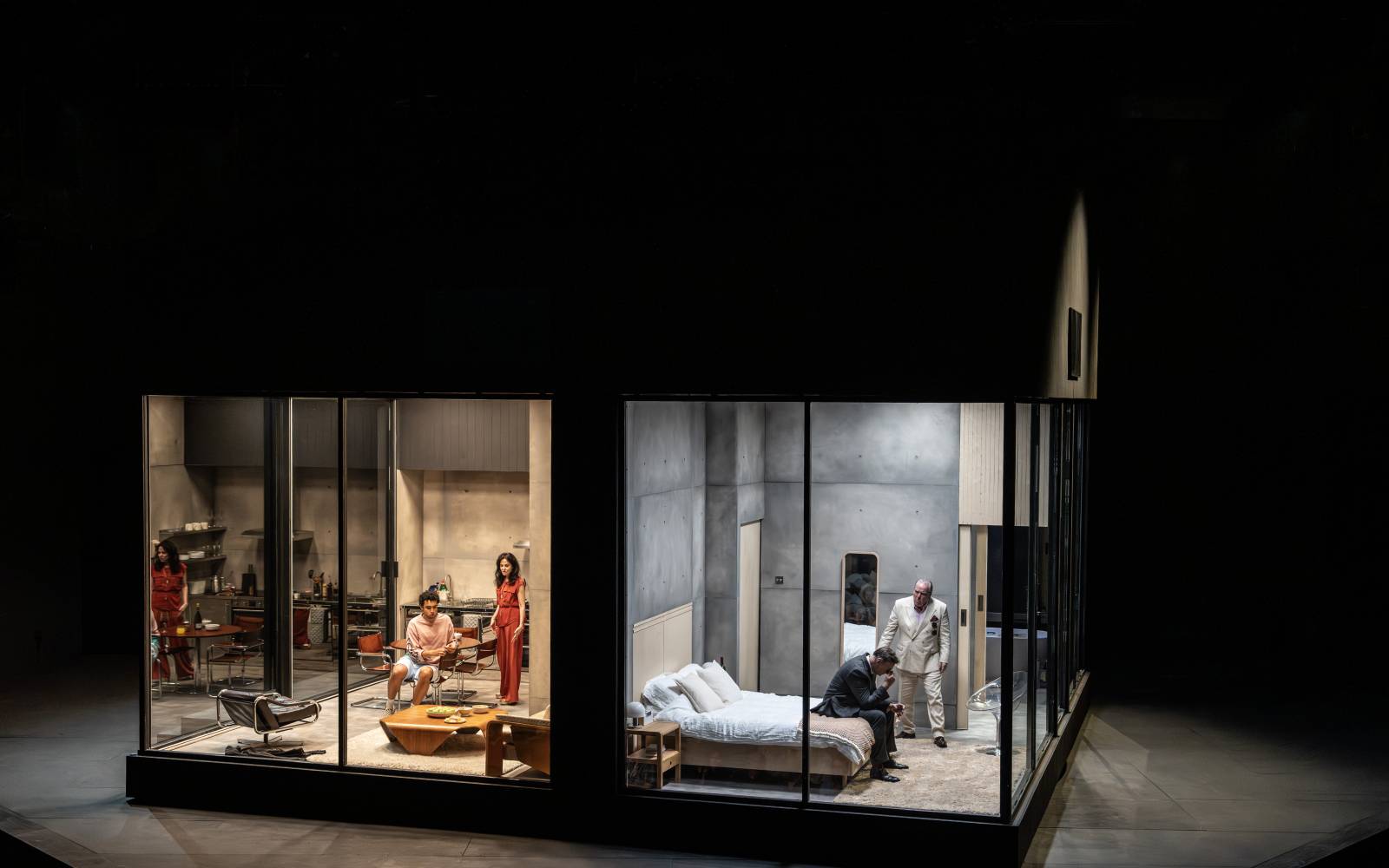
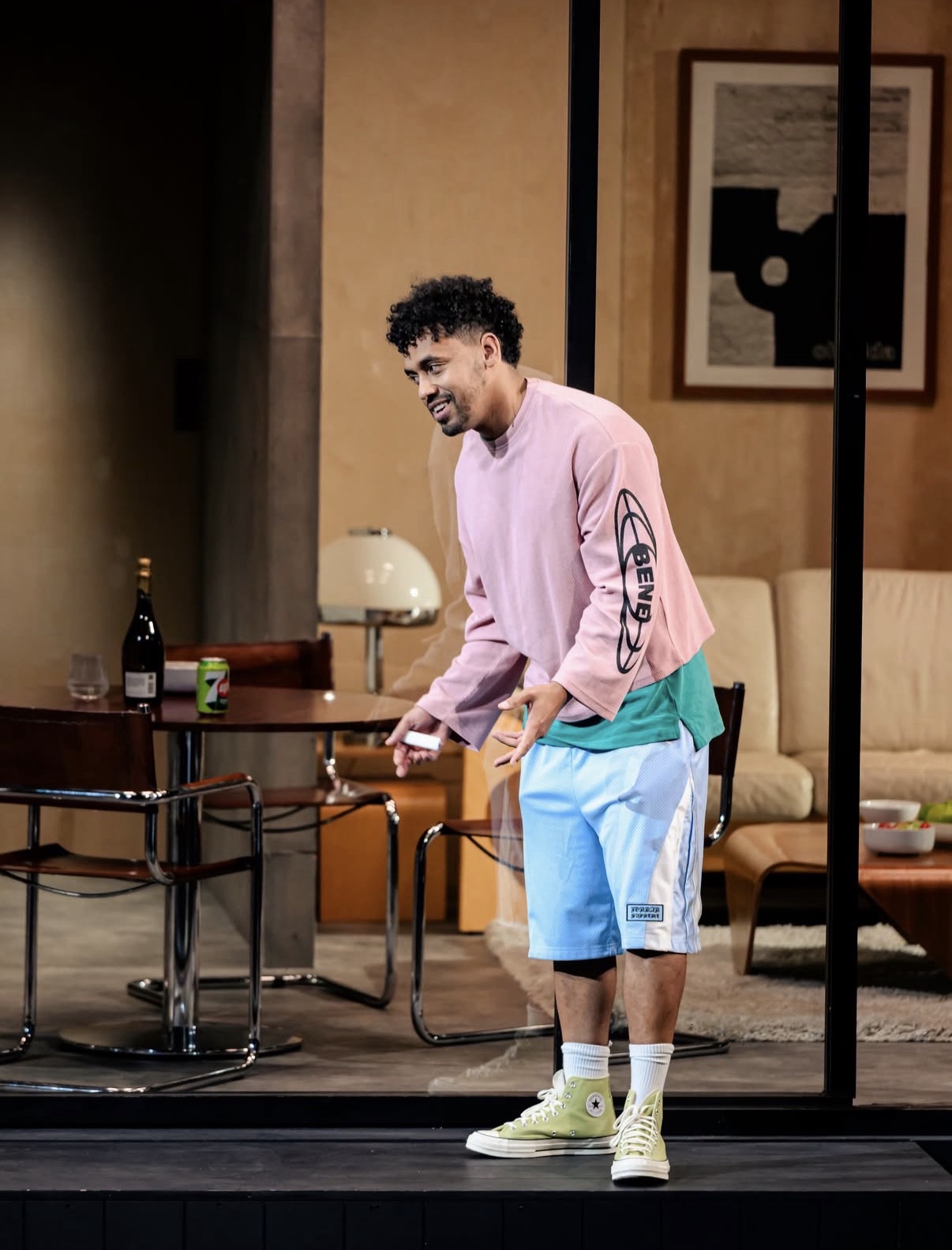
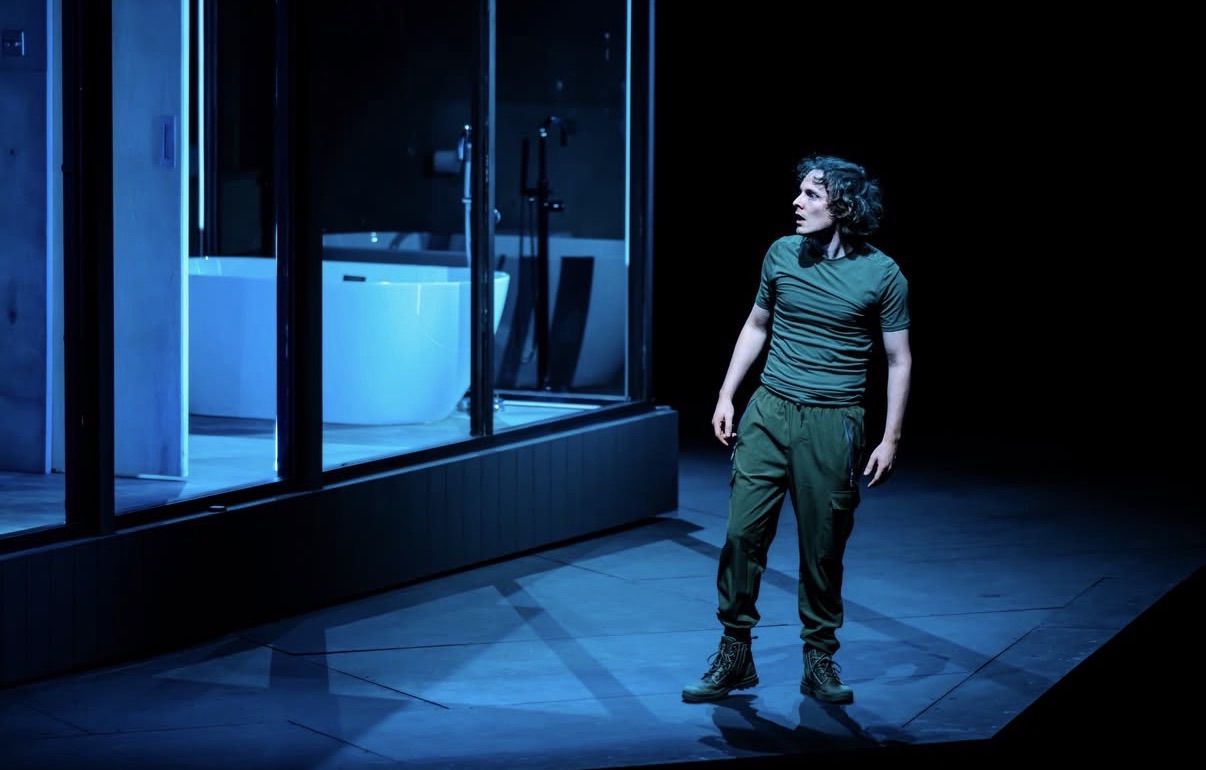
A truly stellar cast perform with total precision for the entirety of The Oresteia‘s mammoth three-and-a-half hour runtime, but they cannot be the first thing called out for praise. Instead, Lizzie Clachan’s set stands out as the immediate star of the show. Revolving as required, we see many rooms of the Middleton household entirely from the outside, gazing in through grand windows through which we common folk may bask in their minimalist paradise. The empty expanse behind the house allows us to imagine the expansive grounds on which the birthday party will be taking place, and Clachan has created a believably lived-in but meticulously-kept household.
Stone’s direction makes equally meticulous work of the space, with characters moving between rooms and even floors, speaking to one another as they go or else continuing silenced conversations as their current room drifts slowly out of view. Under his guidance, the cast never feel like they are going through a presumably lengthy list of blocking to arrive in the right place as their movements feel natural to the characters and his positioning of each character well-watched to the moment at hand. Of course, Stone has also helped craft a strong set of performances, having some phenomenal talent at his disposal.
Photography by Johan Persson
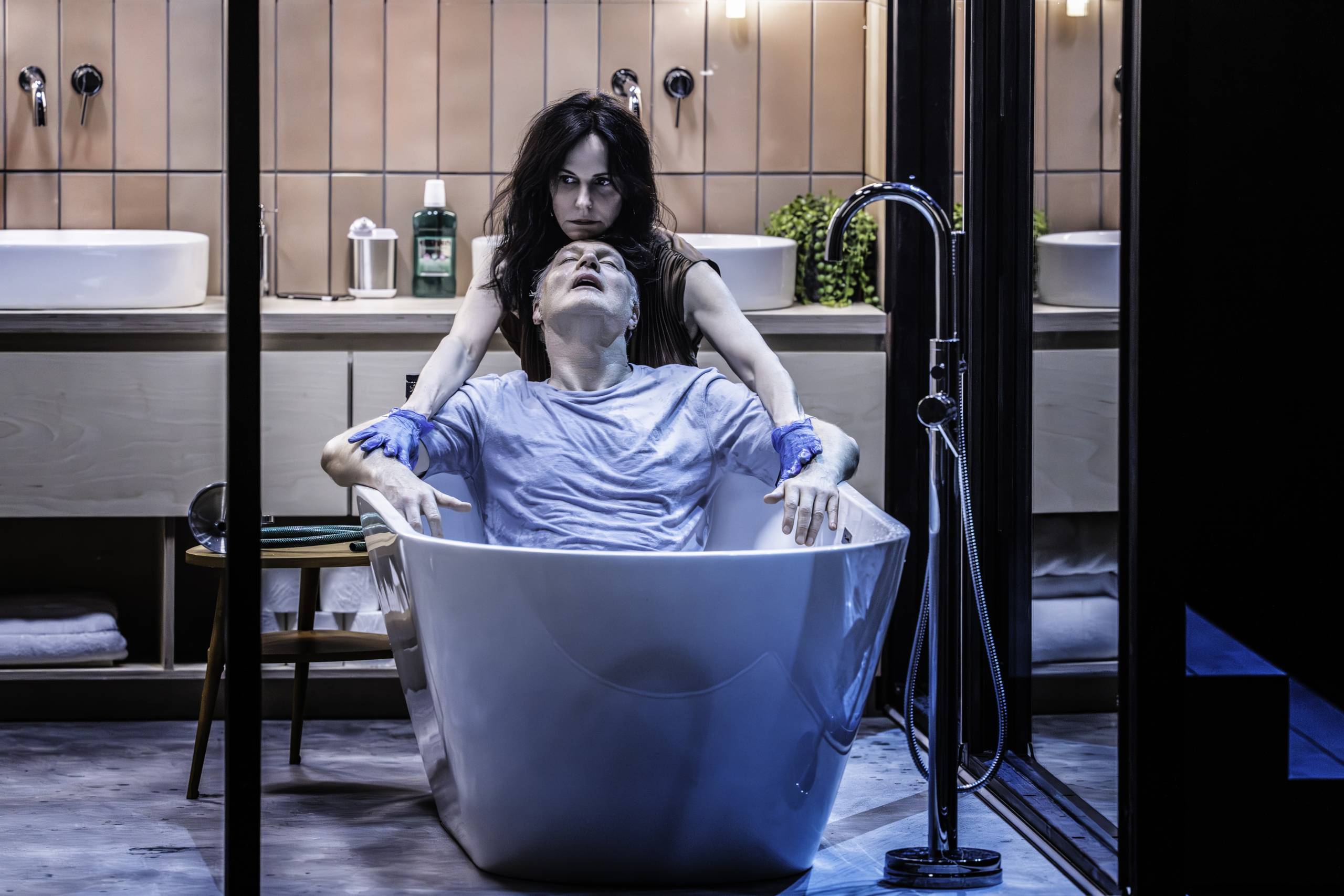
As the Middleton parents, David Morrissey and Mary-Louise Parker are strongly matched in a pair of finely-tuned performances. Morrissey continues his run as one of his generation’s most versatile and underrated stars, vanishing entirely into the blend of cowardice and cruelty that shape Christopher’s difficulty reigning in his children and cowing to his elder brother’s (a deliciously snide Lloyd Hutchinson) demands. In the role of American housewife Montie, Parker runs the gamut from sarcastic snark to methodical malice through the play’s epic length, never showing any signs of losing steam or being anything short of captivating.
Alice, the less highly-praised of the Middleton’s twin daughters, is portrayed by Rosie Sheehy in a performance so firm in its mockery of posh-girl stereotypes that her emotional depth almost comes as a surprise. Despite her absent twin Isobel’s claiming of much more family attention with both her successes and her political protests, Sheehy draws clear connections between Alice and each member of her family, leaving no doubts about these shared histories. Particularly well-formed are her resentment towards her mother, who she feels emotionally abandoned by, and the intimate connections shared with her brother, Augie, and cousin, Lorenzo.

Both Lorenzo and Augie were played by understudies on the night I attended, but there was no shortage of this all-important chemistry. Stepping in as Lorenzo, Andy Umerah first provided some charmingly awkward moments attempting to share family time in a home where he clearly doesn’t feel truly welcomed, intermingled with some alternately humorous and vicious moments with Lorenzo’s father, Jerome. As Jerome, John Macmillan sells the difficulty of feeling left out of a powerful family while remaining undeniably linked to it, before devolving into a truly devastating depression later in the story. He and Umerah work incredibly well together, building a ferocious dynamic which leaves no doubt about the strained nature of their relationship.
In the part of Augustus “Augie” Middleton, understudy George Renshaw does perhaps the best job of selling the decade-long nature of the story, so vivid is his on-stage transformation as the story moves back and forth. His portrayal of his first-dismissive and eventually deeply intimate connection with Lorenzo is particularly commanding, with he and Umerah sharing a striking on-stage connection in both modes. Stone’s Oresteia hinges on Augie’s progressive breakdown as his family’s cruelty settles in being palpable for the audience, and Renshaw proves more than up to this arduous task.
With characters moving between rooms, exiting and entering the house, and their conversations being silenced as the set rotates to let us see into another room, Peter Rice’s sound design certainly faces challenges. Now firmly settled into its run, Rice’s work on The Oresteia is smooth and largely faultless, actors as audible while sealed within the Middleton house as when they step outside it, and a sudden muting of their microphones used to terrific effect in some of the more dramatic moments. Alongside affecting lighting from Nick Schlieper, the team here have given The Oresteia a stirring, powerful aesthetic identity, bolstered further by original music from Katrina Rose.
Emma White’s costume design further aids this identity, the characters being easy to relate to and understand quickly thanks to their appearances. While Montie is well-dressed but firmly based at home, Christopher and Melville are perpetually wearing suits. In particular, a distinction between upbringings is drawn by Lorenzo’s casual-but-pricey wardrobe in the first act, showing that he exists awkwardly between his wealthy family and identity as a still-growing teenager. Lorenzo is connected to wealth without a doubt, but struggling to reconcile his family background and his halfway-outside position within it, and his costuming helps the audience understand this contrast.
Photography by Johan Persson
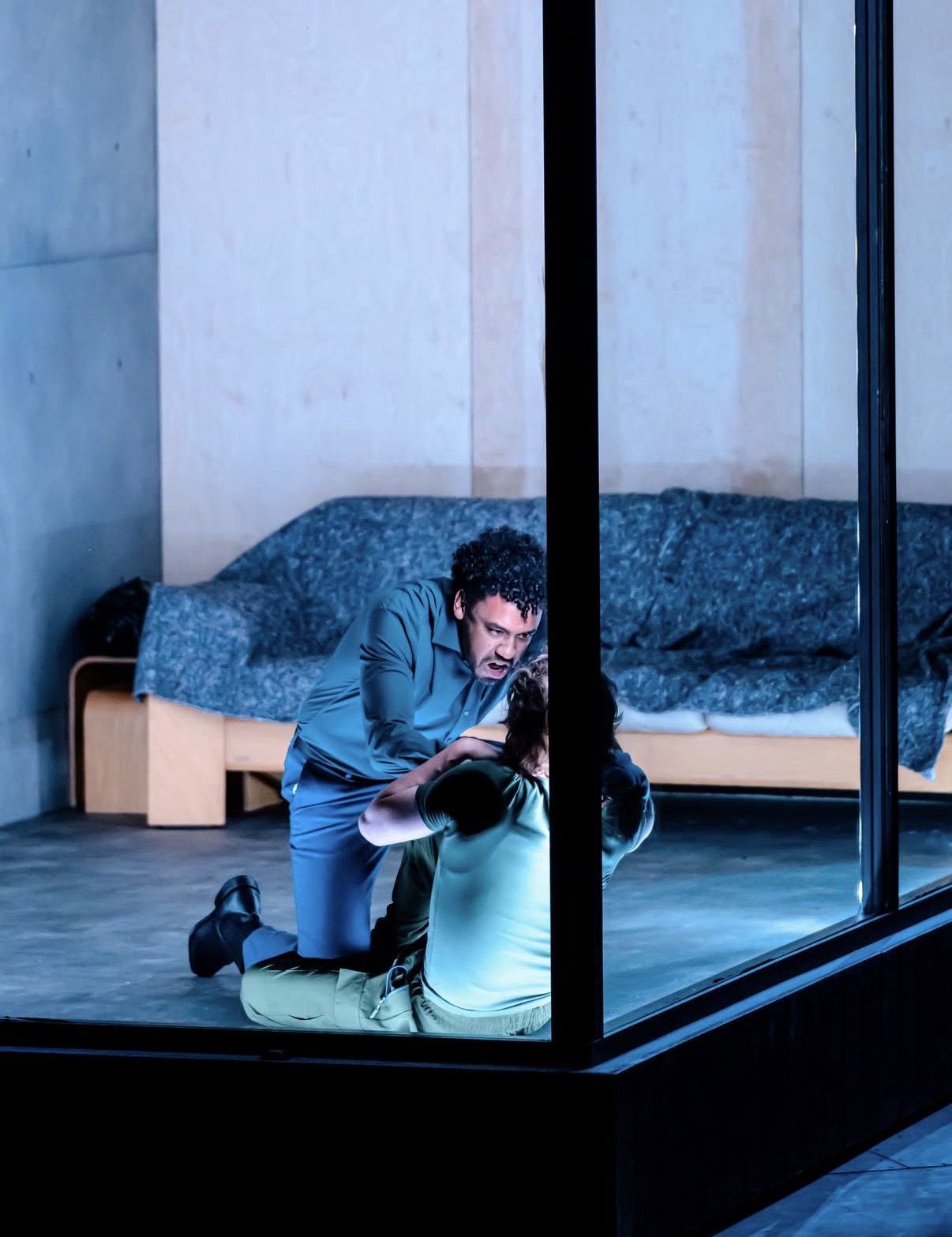
Adapted from a trilogy of Ancietn Greek tragedies, it isn’t too surprising that The Oresteia becomes brutally violent – not to a sickening visual degree, but certainly to a shocking one. Greatly aiding Simon Stone’s handling of these provocative shifts is Sam Lyon-Behan, whose fight direction has helped to create some shocking, legitimately thrilling moments. As much as I desperately want to specify moments of characters involved, that would surely be far too big a spoiler.
With a cast and crew this strong, with so much to praise that this review would become ludicrously long – my apologies to the remainder of the team behind The Oresteia, and to Alyth Ross and Rakhee Thakrar’s dazzling performances. Walking out of Simon Stone’s The Oresteia, I was shocked by how quickly three-and-a-half hours had flown by, and desperate to return to see other combinations of actors. While it’s difficult to imagine Umerah and Renshaw being outmatched, I can’t help but wonder what other textures are bought to this thrilling text not only by its principle cast, but by other combinations of understudies stepping into such bold, well-written parts.
Photography by Johan Persson
Final Thoughts
Brutal. Brave. Brilliant.
⭐️ ⭐️ ⭐️ ⭐️ ⭐️
With his take on The Oresteia, Simon Stone does what he did a decade ago with his adaptation of Lorca Yerma – places modern twists on powerful characters within literal and metaphorical windows, and makes them equally as commanding as modern-day roles. Both his writing and direction are razor sharp, with the assembled cast and crew matching his creative spirit beautifully. The result is visceral, vibrant, and vice-like in its grip.
Photography by Johan Persson




Leave a Reply